Article
Building a trustworthy foundation for integrating cell-line and patient-derived drug-response data.
4-minute read
By Pedro Noah Milarski and Kimberly Robasky
The opening article in this series, The Missing Data in Cancer Drug Development?, made the case that cancer AI is constrained by the evidence available to train it. Much of today’s cancer data describes what a tumour is, rather than how it responds to a drug.
Public drug-response data has never been easier to obtain. Screens, expression profiles and mutation calls for hundreds of cell lines can be downloaded in an afternoon, and processed versions arrive with modelling papers, ready to load. Availability is the easy part.
Comparability is harder. It means two numbers can sit in the same column because they measure the same thing, in the same direction, on the same scale, with the same account of what is missing. Nothing about a download guarantees any of that. And the processing that made a dataset convenient may have quietly decided which biology it still contains.
What if the next breakthrough cancer drug already exists, but the signal that would find it is being lost upstream, to data-engineering problems the field has not yet solved?
To make this concrete, consider something our team ran into while examining a processed cell-line dataset released with a peer-reviewed modelling study. BRAF, one of the best-known genes in cancer biology, was absent from the published expression panel. The drug screen was not the source of the omission, and neither was the expression array: the array carries a BRAF probe set, and the gene is present in the data provider’s own processed release of the same arrays. BRAF was most likely lost one step later, at probe-to-gene annotation: in the standard annotation package for that array, BRAF’s only probe set is assigned to two genes, and the package’s default map excludes every probe set assigned to more than one gene.¹ Nothing in the published matrix marked the gap. The gene was simply missing from the representation before it entered our pipeline.
The matrix looked clean. The biology was narrower than it appeared.
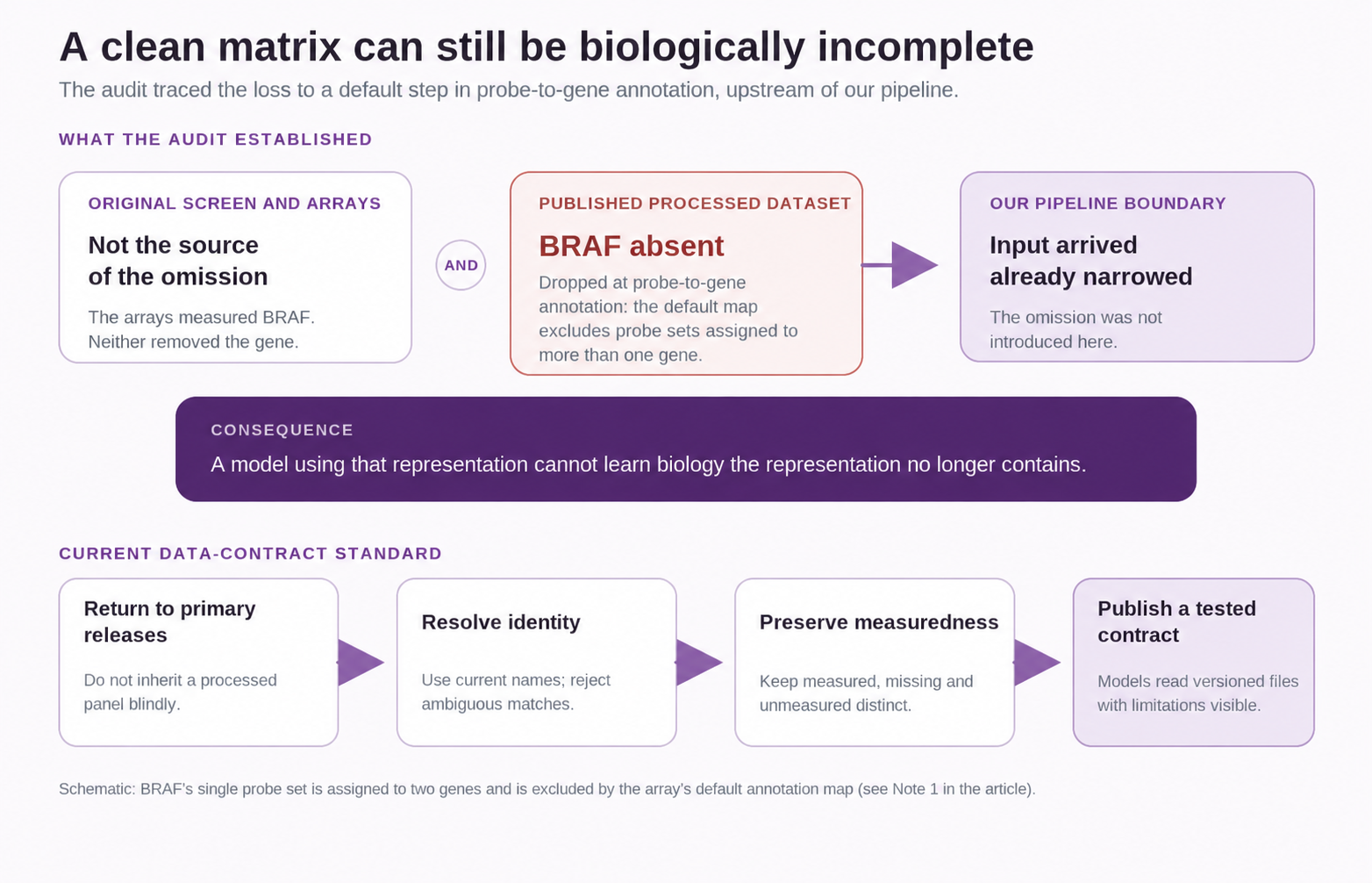
Figure 1. BRAF was represented on the original array but absent from the published matrix, consistent with a default annotation rule that excludes probes assigned to more than one gene (see Note 1). The published matrix carried no marker of the loss, so the representation entered our pipeline already narrowed. The lower lane shows the current data-contract standard.
A download is not yet a data contract. Between source files and a model sit four agreements: measurement meaning, missingness, identity and tests.
Large public resources such as GDSC and Cell Model Passports are extraordinarily valuable. They are also the products of different assays, release cycles and naming systems.
A gene may appear under a historical symbol. The same compound may appear as a research code, salt or brand name. A high response value can mean sensitive in one file and resistant in another. A zero may be a real measurement, or it may have been used to fill a measurement that never existed.
Those are not formatting details. Each one changes the question a model believes it is answering.
The source value stays intact. What we add around it is an explicit record of what it means.
Our first rule was to return to primary releases and preserve their meaning. Expression remains on its native scale at the ingestion boundary. Unmeasured genes remain missing, with an explicit mask, rather than becoming biological zeroes. Different response statistics remain different statistics: AUC is not silently converted into IC50, and neither is relabelled as something else.
This makes the data less cosmetically uniform, but more scientifically honest.
We align gene names against current nomenclature while rejecting ambiguous matches. We resolve drug names to canonical molecular parents, and an unresolved identity stops publication rather than receiving a plausible guess. Separate assays remain separate even when they cover many of the same cell lines and compounds.
Rejecting ambiguity is a defensible choice. The failure in the example above was that nothing recorded it. Our alignment step reports what matched, what resolved through a synonym and what was rejected, and the measured-gene mask records what each assay actually measured. Nothing is dropped silently.
The aim is not to force every source into sameness. It is to make differences explicit enough that downstream analysis can handle them responsibly.
Without tests, those agreements decay.
The finished output is a versioned data contract: what was measured, what was missing, what each response value means and which compound it belongs to. Automated checks re-test those guarantees whenever the pipeline changes. Model training reads that published contract; it does not reach back into raw files or source-specific parsing code.
That separation matters because it makes errors easier to find, corrections easier to version and results easier to reproduce.
On the cell-line side, this work creates a trustworthy reference before a separate system learns from it. In parallel, organoid and xenograft cohorts must be rebuilt at the donor level, characterized and versioned before they can support model transfer.
The two streams do not become one giant spreadsheet. They meet later, at an experimental model-transfer step.
That is the foundation we are building - not completed clinical validation, and not a system for choosing treatment for an individual patient. The goal is better evidence for drug-development decisions, with every limitation kept visible.
The model is the visible part. The contract beneath its inputs determines which biology reaches it. Before cancer AI can learn biology, its data pipeline has to stop inventing it, and stop discarding it.
Those same principles become harder to apply when the biological unit is a donor represented by an organoid, xenograft or another patient-derived model.
For pharma R&D, the data contract makes the evidence base inspectable: what was measured, what was missing and which signals were available to the model. It provides a traceable foundation for deciding which questions existing evidence can support, and where further experimental evidence is needed.
How BRAF went missing. The dataset comes from Xia et al., BMC Biology (2024), which combined cancer drug-response data with gene-expression measurements from an earlier public study. BRAF was represented in the original measurements but absent from the published dataset. Our investigation found that a routine data-processing default provides a compelling explanation: measurements associated with multiple genes can be silently excluded.
We reproduced this effect and, with one documented manual identifier match, accounted for every gene retained in the published dataset. The same default would also have kept about forty genes the dataset does not include, so it explains the omissions without being the authors' full procedure, which remains undocumented. The result illustrates how valuable biological information can disappear before AI development even begins.
A forthcoming companion article will explore the technical investigation, evidence, and broader implications for AI-ready cancer data.
Cancer AI: From Evidence to Models is a short series for pharma R&D teams. A lab in the loop depends on two things: evidence that means what it appears to mean, and tests that show what a model can and cannot do. In the pieces that follow, our technical team explains:
Together, the series will show why this evidence gap matters to pharma R&D, why we believe closing it requires an integrated lab-and-model approach, how our team is building that system, and how work on immediate development questions can strengthen a broader evidence platform over time. We will remain clear about what the evidence establishes today and what we are working to prove next.
Imagine testing a cancer treatment on a patient’s tumor before giving it to the patient.
We grow living tumors from patient samples, test drug responses and use the results to teach our AI which treatments could work - and for whom.
Test the tumor. Predict response. Design smarter trials.
Connect with us at contact@pwbio.ai.
Fixing the engineering problem
Article
Imagine testing a cancer treatment on a patient’s tumor before giving it to the patient. We grow living tumors from patient samples, test drug responses and use the results to teach our AI which treatments could work - and for whom. Test the tumor. Predict response. Design smarter trials.

Why cancer AI needs a lab in the loop
Article
Imagine testing a cancer treatment on a patient’s tumor before giving it to the patient. We grow living tumors from patient samples, test drug responses and use the results to teach our AI which treatments could work - and for whom. Test the tumor. Predict response. Design smarter trials.
Redefining precision medicine
ARTICLE
Pathway Bio is building a functional precision medicine platform to predict which therapies will be most effective for individual patients. We spoke to its CEO and co-founder Bobby Kaura about his experiences of launching the start-up and the KQ Labs entrepreneurial programme.

